
Venture Boldly
Office of Communications
2 East South Street
Galesburg, IL 61401

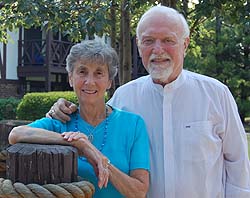
V.R. "Swede" '51 and Martha Jacobsen Roskam '52
The journey is finally over. After seven years, hundreds of phone calls, and thousands of miles, V.R. "Swede" '51 and Martha Jacobsen Roskam '52, returned the last of 37 dog tags they found at a market in Vietnam to its rightful owner.
The Roskam’s journey began in September of 2001 in Ho Chi Mihn City, where Martha found the basket full of tags at a market. She told Swede, who completed the Knox ROTC program and served during the Korean Conflict as a platoon leader and company commander, and he was incensed. “He said those should not be sold on the streets as souvenirs and trivia,” said Martha, who returned to the market the next day and purchased all the tags for $20.
When they returned home, Swede and Martha discovered that finding the owners of the dog tags would not be as easy as they had envisioned. The only information on the tags was the soldier’s name, blood type, religion, and serial number. It took the assistance of their son Peter Roskam, then an Illinois state senator, now a U.S. Representative (6th District, Illinois), to find the last known address the military had for each of the men.
With the information that his parents had been able to gather, Roskam telephoned the National Archives' National Personnel Records Center in St. Louis, Missouri.
Peter Roskam recalls that the center's director said, “'Senator, give me one of the names.' I could hear her typing it in.” Moments later, he said, the director replied, “It's a match. Give me another one.” After checking a few more tag names, Peter Roskam said, it was clear that the tags were quite likely authentic.
A private investigator was hired to track down current addresses. “The last address we had for many of these guys was 40 years old, so there were a lot of twists and turns along the way,” said Martha.
The couple decided to personally return each tag when they could. Their first visit was to a woman in Phoenix, Arizona. Her nephew, whom she had adopted along with his eight brothers and sisters, was a Marine. While hiking, his platoon stopped to rest by the side of the road. He sat on a land mine.
“Until then, it had been sort of an academic interest for me. My husband is the one who really made it all happen. But then I walked into this very modest home and saw this woman. She had the flag that had been given to her. The first time we saw one another we embraced and we both wept as mothers. It wasn’t hard, but it was very poignant. From then on, it took a different dimension for me.”
Of the 37 tags, four of the soldiers had been killed in combat. Others had died since the end of the war. Among the many whom the Roskams visited to return their tags were a police officer in Los Angeles, a city maintenance manager in Florida, and a postman in New York.
Some remembered the exact moment when they lost their tags. One man was rappeling in a fierce firefight and his helmet was shot off. He lost the tags with the helmet. Another put his tags in his duffel bag when he left Vietnam. The duffel bag never made it home.
“One fellow was out in the field a lot and said ‘When all you lost was a dog tag, it wasn’t a bad day,’” said Martha.
The last dog tag was given back to Gerald Trout of Garland, Texas, last month. In a moving ceremony, Gerald was given not only his dog tags, but a bronze star, purple heart, and commendation medal for heroic action in combat that he was to have been awarded 40 years earlier but never received.
Martha says their seven year journey has not been easy, but it’s been worth the effort. "We have been so blessed by meeting these wonderful guys who gave so much of themselves at that time and suffered so much," says Martha. "It was something we were supposed to do -- and we did it."
Published on October 20, 2008

https://www.knox.edu/news/journey-to-return-dog-tags-ends
Printed on Tuesday, April 29, 2025