
-
Apply to Knox
Ready to see yourself at Knox? Applying is the first step. We’ll help you explore academics, campus life, financial aid, and everything else you need to get started.
Get started. -

-
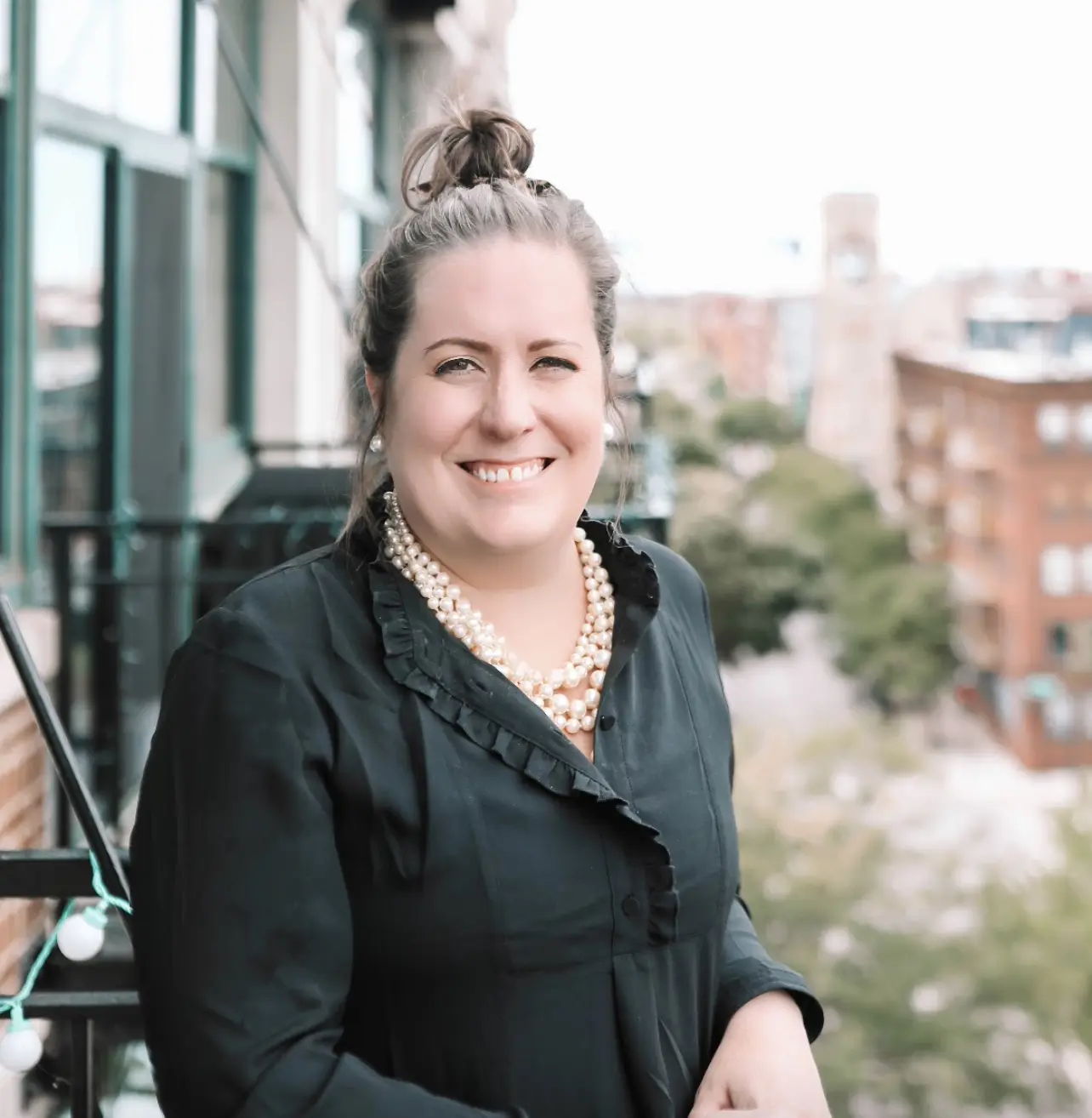
Mary O’Malley ’04
Chicago, Illinois
Major: Anthropology and sociology
Mary O’Malley ’04 is an independent college counselor and writer who helps families navigate college admissions with clarity, steadiness, and a healthy skepticism of anyone yelling “crisis.”
As part of her work as an independent college counselor, Mary O’Malley ’04 writes Admitted-ish, a Substack that began as a response to panic-driven admissions culture and has grown into a broader philosophy of calm, humane advising. Her essays blend strategy, storytelling, and dry humor to challenge urgency culture and remind students that confusion is not failure.
What does a Knox education mean to you?
What does it not mean? It has prepared me for everything, and I don’t say that lightly. When you have a foundation in the liberal arts, you can think critically, you can read and analyze things, and you’re just better prepared for the world around you.
How has your education prepared you for what you are doing now?
There was a statistic when I was a student, from somewhere like the Bureau of Labor Statistics, that said you would have seven careers in your lifetime.
A lot of what Knox did for me was teach me how to think and how to be critical about things, and that has been a gift that keeps on giving in how I approach the world and in the work I do with students.
With your current profession, you help high school students who are looking to take that next step. What are some values that Knox imparted?
Everyone at Knox has their people—the ones who quietly shape how you think.
Jo Bradley ’04, one of my closest friends to this day, would absolutely not let me get away with lazy thinking. I’d say something half-baked and she’d pause, stare at me, and say very calmly, “You can do better.”
And the annoying part? She was always right.
Julie Larsen ’04, my other best friend, showed me something different but just as important: rigor and kindness can live in the same room. The smartest people in the room didn’t have to step on anyone to get there. They believed a rising tide lifts all boats. Collaboration wasn’t a buzzword — it was how things actually worked. The world can be cutthroat, sure. But if you can think with people instead of against them, you’ll go much farther.
And then there was Jonathan Powers — beloved economics professor, swim coach, and water polo coach. While perhaps I’m most proud of being one of the students who coined the nickname JPow, he taught more than just economics. It was posture: how to lean in, how to ask the sharper question, and how not to be fooled by the easy answer.
Jonathan was relentlessly curious. What I realized later is that curiosity isn’t a personality trait — it’s a discipline.
Every lecture ended the same way: Questions? Comments?
Not as a formality, but as an invitation to keep the conversation going.
How has mentorship impacted you?
I am who I am because of the mentors I had at Knox College.
People like Jonathan Powers, and Chris Boyle ’92 and Susannah Gillan Eastwick ’99 in the Office of Admissions, where I worked as a student employee for four years — and eventually in my first job after graduating.
What they gave wasn’t just advice. They gave me room.
Room to ask the question I wasn’t sure I was allowed to ask.
Room to say, “I don’t understand this yet.”
Room to admit that the first job or two after college can feel confusing and full of pressure.
They made it safe to be unfinished.
When I think about how that shows up in the work I do now, it’s this: listening.
When you work with high school students — when you’re in a position of more knowledge than they are — you’re guiding people through a process that doesn’t have many clean answers. You have to resist the urge to jump in immediately. You have to let the silence sit for a moment. You have to give someone else the space to figure out what they actually think before you hand them your version of the answer.
Knox taught me how to do that.
How to listen long enough for students to find their own thinking.
How to recognize when it’s time to step back — and when it’s time to step in.
Whether it’s college admissions, a first job, or figuring out who you want to be in the world, the real work begins when someone feels safe enough to go a little deeper.
Knox made that possible for me.
What put Knox on your radar?
At one point, Cindy Kasten, my college counselor at the Latin School of Chicago, sat me down and said, very matter-of-factly, “Here’s what I know about you: you value relationships. You want to be in a community where people actually know you.”
Then she handed me a list of colleges. It’s framed on my office wall 27 years later.
Knox College was on it. At first, it wasn’t at the top of the list. But the more I learned about it, the more something clicked. It felt comfortable. Familiar.
The best way I can describe it is this: it felt like coming home.
What were some of the things you were involved in during your time at Knox?
Like most Knox students, I was rarely doing just one thing. People there tend to stack their lives pretty full.
For me, outside the classroom, it was swimming and water polo. Between the pool and the Admissions Office, that was a large chunk of my world. At one point, I had a radio show with Shirlene Love ’04. I was also a member of Pi Beta Phi — friends who, to this day, still keep an active group text going.
How much do experiences outside the classroom shape life after college?
When I work with students, a lot of the conversation eventually comes back to one word: authenticity.
Not the buzzword version. The real version — the uncomfortable one.
Many of the families who come to me arrive with a very clear plan already in their heads: apply to every Ivy League school, add Stanford and MIT, and keep the University of Chicago in the mix as a “backup.”
At some point I gently — but pretty directly — tell them that this plan doesn’t actually make sense.
Because if you’re not willing to ask the harder questions — What do I want? Who do I want to be surrounded by? What kind of learning environment actually fits how I think? — then you’re doing yourself a real disservice.
There are only a handful of moments in life when you get to choose the community you’ll be part of.
The college process is one of them.
It’s worth slowing down long enough to choose wisely.
What did community mean to you at Knox?
A few years ago, I attended a graduation ceremony for a former student at the University of Notre Dame. Notre Dame isn’t enormous — at least not in terms of undergraduate size — but she told me about a game she and a friend played while walking around campus: “I didn’t know that person.”
As in—spotting someone and realizing you had never crossed paths.
That game doesn’t really exist at Knox College.
I had always been in smaller, more intimate learning environments. I’m a product of independent schools, so community wasn’t an add-on — it was part of the foundation.
At the time, I’m not sure I could have articulated exactly what I was looking for.
But looking back, it’s clear that choosing Knox changed the trajectory of my life.
There’s really no other way to say it.