

Welcome Message from John Lawler ’88
Chair of the Board of Trustees
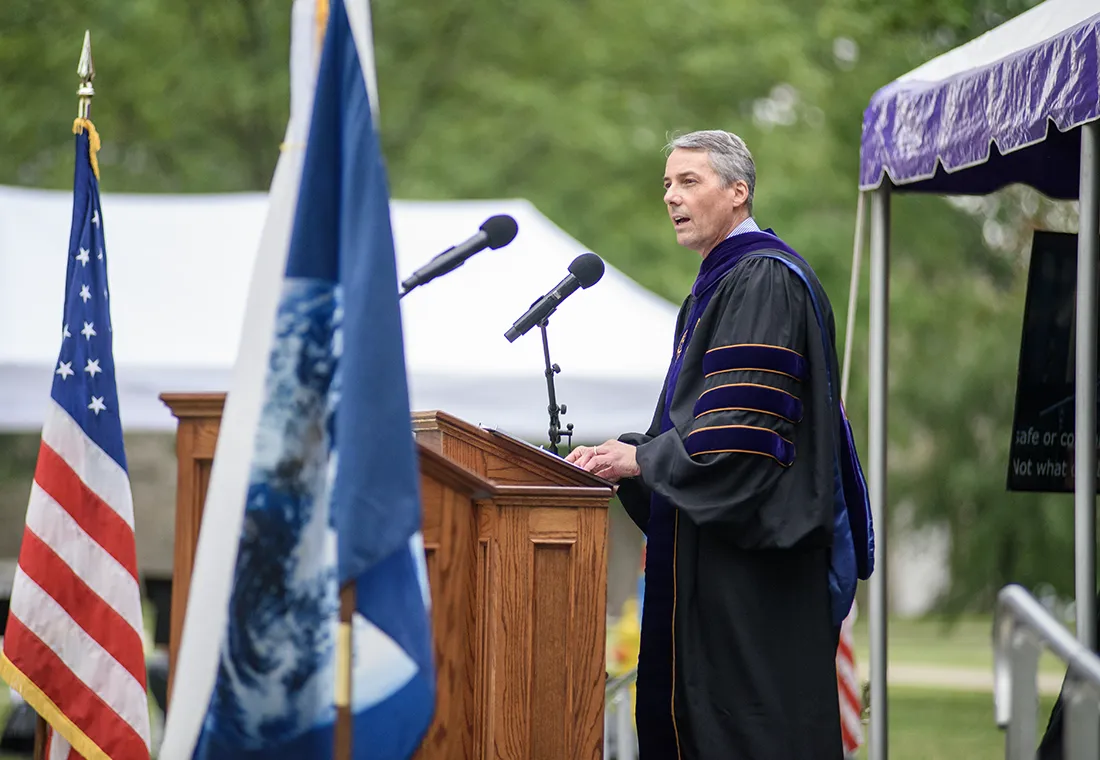
Good morning.
President McGadney, Justin, Deborah, Dorothy, faculty and staff, family and friends—and most importantly, the Knox College Class of 2026. Welcome, and congratulations.
Now, graduates, this day is yours, but before we go any further, I want you to do something for me. Turn around. If you can. As best you can. Look at the people behind you.
These are the people who made today possible—the early mornings, the tuition bills, the worry, the encouraging texts, the quiet sacrifices they never mentioned. The love that carried you through your dark days.
Give them the thank-you they’ve earned.
Like many of you, I was a first-generation college student. I arrived at Knox not entirely sure I belonged here.
Two professors—Pillsbury and Anderson—saw something in me I couldn’t yet see in myself. Whenever I looked for the easy way out—and I looked often—they pushed me toward the harder path.
So, before you leave here today, find the professor who did that for you. And thank them. Forty years from now, you’ll remember that conversation long after you’ve forgotten every grade you’ve earned.
Now, you are graduating into a world that is genuinely unsettled. The economy is shifting faster than anyone can track. Institutions that felt permanent feel vulnerable. Public life is more polarized than anything your parents knew.
And the noise is relentless.
We live in a moment where speed beats accuracy, reaction beats understanding, and confidence passes for wisdom. And I won’t pretend this moment is easy. Because it isn’t.
But you have the depth to meet it.
Let me explain why.
The debate over whether a liberal arts education is still “worth it” in the age of technology misses the point entirely.
You did not come to Knox to learn a skill that a machine may soon replicate.
Knox gave you something harder to build and harder to replace—a way of seeing. Not what to think. But how.
Knox taught you to ask the question no one else is asking—and then follow it up to the uncomfortable answer.
These are not soft skills. They are the skills that will determine who shapes the future and who gets shaped by it.
Here is the central truth of this moment: As calculation gets cheaper and more abundant, judgment gets more valuable. The biggest questions of this era—about technology, about work, and the kind of country we want to be—are questions of judgment.
These are not technical questions.
These are Knox questions.
You can feel that history right here, in the shadow of Old Main.
In October 1858, not far from where you’re sitting, Abraham Lincoln and Stephen Douglas stood on this campus and debated whether one human being should own another.
Knox had already decided.
This college was a stop on the Underground Railroad when doing so was costly, dangerous, and deeply unpopular.
Barnabas Root came to Knox when the doors of almost every American institution were closed to him. Knox opened theirs. In 1870, he became one of the first Black college graduates in Illinois.
Don’t let the distance of history make that feel abstract.
Think about what it actually took — not the idea of it, but the daily act of it. The repeated choice, made in real time, to do what was right rather than what was safe or comfortable.
Not what can be done, but what should be done.
Class of 2026—you are the next link in that tradition.
And Knox has been here before. Not once—but every moment when the easy answer and the right answer pointed in different directions.
The moral stakes are different now. The structure of the moment is not.
We have technology today that makes calculation and certain kinds of thinking faster, cheaper, and more abundant than at any point in human history.
The question is not whether to use it. The question is what we use it for. And who decides.
You are the first class in Knox history whose time here unfolded alongside a technology that could, on demand, write your essays for you and offer the illusion of learning.
I won’t claim every one of you always resisted the easy path. I know I didn’t—and the temptations I faced were far less sophisticated.
But you stayed. And you did the work of learning to think. That is the harder path. And you’re sitting in those chairs because of it.
I’ve spent decades in rooms where the pressure to find the quick solution overwhelms everything else. And here is what I’ve learned:
The person with the most data or the fastest answer is rarely the most valuable person in the room. It’s the one who steps back when everyone else steps forward. It’s the one who reframes the problem before anyone races to answer the wrong question.
That is judgment. Knox built it in you.
And that is why this moment belongs to you—not to technology.
I’m not asking you to adapt to the world that technology companies are building. I’m asking you to help shape it.
The future will be decided less by the people who invent these systems than by those who question them, govern them, and use them wisely.
That is your work. That is Knox’s work.
I walked off this campus uncertain. But Professors Pillsbury and Anderson had given me something I didn’t fully understand yet.
A way of seeing. A habit of judgment.
The tools Knox gave me built everything meaningful that came after.
You don’t have to change the world this week. Whatever—whatever room you walk into, be the one who steps back. Be the one who asks the question no one else is asking. Resist the fast, easy answer. Build the habit of judgment the same way you built it here—one hard choice at a time.
Before you go: Find your professor. Thank your family.
For nearly two centuries, Knox has asked the harder question.
Not what can be done, but what should be done.
Class of 2026—that question is now yours.
Congratulations.
Published on June 07, 2026