
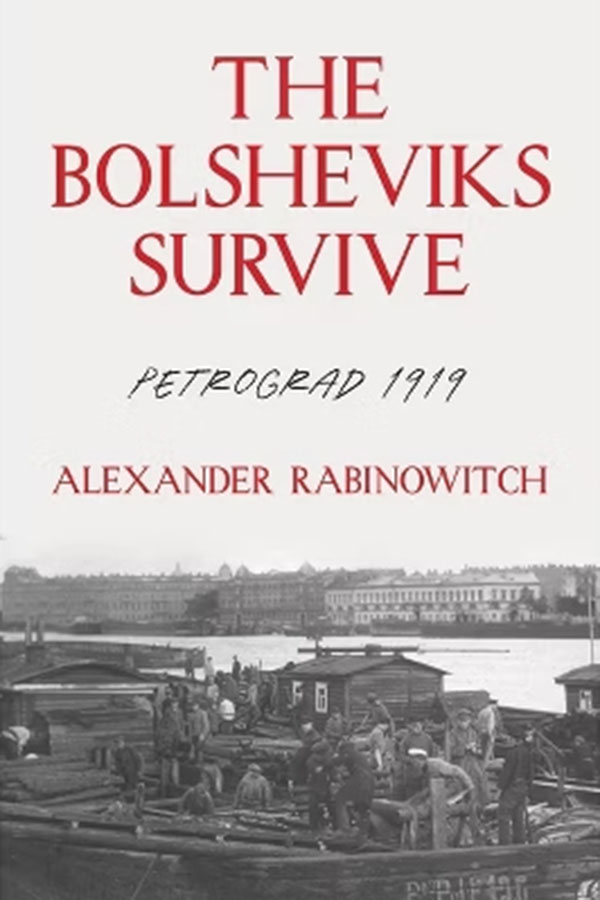
Any list of Knox alumni who have had a major impact on the world has to include Alexander (Alex) Rabinowitch ’56, a 1997 Honorary Degree recipient whose scholarship transformed our understanding of the Russian Revolution. He did so through publication of his scrupulously researched landmark tetralogy, Prelude to Revolution; The Bolsheviks Come to Power; The Bolsheviks in Power; and, a month before he died on June 16, 2026, The Bolsheviks Survive. Nothing better illustrates his reputation among historians than his being asked by the editors of the most ambitious encyclopedia project published in Russia after the demise of the Soviet Union to write the entry on their Revolution.
What makes his work stand out so much? Note the title of his masterpiece, The Bolsheviks Come to Power, not “seize” it. Through painstaking research, Alex challenged Cold War-era Western interpretations that portrayed the Revolution as a coup masterminded by Lenin and his conspiratorial, tight-knit party and Soviet-era accounts that sanitized it. For readers interested in exploring his work, The Bolsheviks Come to Power remains an excellent place to begin. If you’re a polyglot, you can read it in a number of languages.
Alex was not a typical Knox student—if there was or is such a thing, but he had a typical transformative Knox experience. He had his eye on Knox after the family moved to Urbana-Champaign in 1947. How the Rabinowitches found their way to the Midwest is a fascinating tale in its own right. Fleeing Russia in 1918, his father earned a Ph.D. in Berlin and afterward studied with Nils Bohr in Copenhagen. In 1932, Eugene married Anna Maiersohn, an actress then performing with a Russian theater troupe touring Europe. Born in London in 1934, Alex and his twin brother, Victor, had a peripatetic childhood, for in 1938 the family emigrated to the United States, where Eugene accepted an appointment at MIT. In 1942, he became a founding member of the Manhattan Project. The family then moved to Chicago.
Alex’s liberal arts education at Knox primed him for graduate study in international affairs at Chicago (M.A.) and in history at Indiana (Ph.D.). After a brief stint at the University of Southern California, he joined Indiana University’s history department and remained there until retirement. In Bloomington, he and his wife, Janet, former director of Indiana University Press, nurtured generations of future Slavicists. That’s where I had the privilege of working with him. More than a teacher, mentor, and role model, he became a steadfast best friend. I am honored to salute the enduring legacy of this Knox alumnus—scholar, mentor, and mensch.