

Former Peace Corps Director Speaks at Knox Peacebuilding Conference
Story by Laura Pochodylo '14
Photo by Clara Conover '16
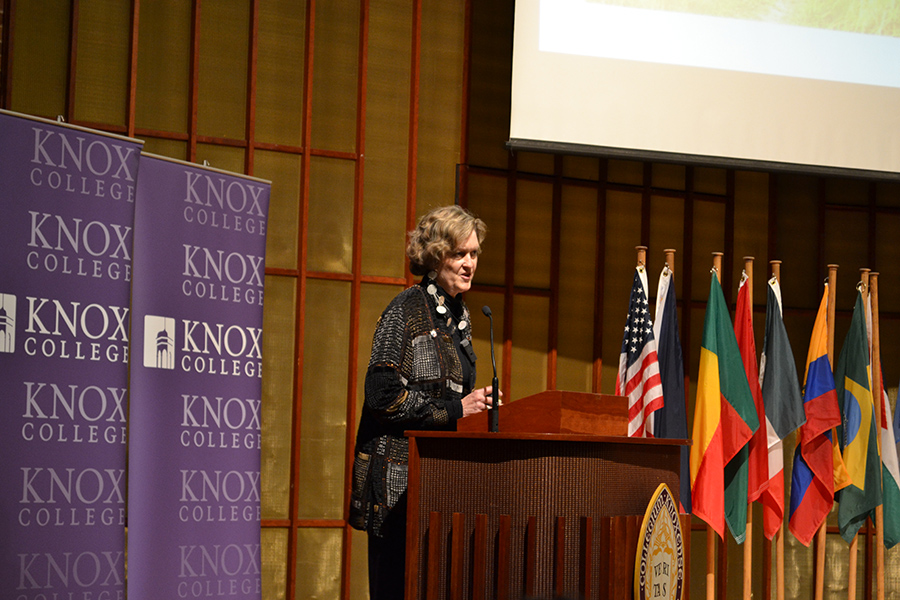
The importance of cultural exchange through stories was the topic of former Peace Corps acting director Jody Olsen's keynote address at Knox College's first peacebuilding conference.
Olsen's keynote, titled "Storytelling: A Key to Peacebuilding Locally and Globally," focused on stories from Peace Corps volunteers in China, Thailand, and Togo. Sharing stories and experiences from abroad is part of the Peace Corps' goal of cultural exchange.
"Storytelling and Peace Corps are synonymous," Olsen said.
Friday's keynote address was the start of the peacebuilding conference, which was organized to celebrate the five-year anniversary of Knox College's Peace Corps Preparatory Program. The April 12-13 conference -- "Work That Matters: Engaging the World After Knox College" -- featured a peacebuilding workshop and discussion panels with returned Peace Corps volunteers, KnoxCorps students, and Knox alumni serving in AmeriCorps. (Read more about the rest of the conference here.)
The event was funded by a United States Institute for Peace grant secured by Knox faculty member Robin Ragan, director of the Peace Corps Preparatory Program, associate professor of modern languages (Spanish), and director of the Stellyes Center for Global Studies. The conference was supported by the Public Education for Peacebuilding Support initiative of the U.S. Institute of Peace and Knox's Stellyes Center for Global Studies.
"I am honored that the U.S. Institute for Peace has selected Knox for one of its very competitive grants in peacebuilding," said College President Teresa Amott.
Amott remarked on the importance of the Peace Corps both to Knox College and herself.
"The Peace Corps has always been a great inspiration to me," Amott said, describing it as "a symbol of what President Lincoln would refer to as the ‘better angels of our nature.'"
Olsen, who is currently a visiting professor at the University of Maryland School of Social Work, delivered her address from a stage decorated with flags from countries around the world where Knox alumni have served in the Peace Corps.
A total of 185 Knox alumni have served in the Peace Corps since its founding in 1961, and more than 60 students have passed through the Knox Peace Corps Preparatory Program since its establishment five years ago. There are currently 11 Knox alumni serving as Peace Corps volunteers, and four more will be on their way later this year.
"I feel extra lucky to be here because I know Knox, I know what you do and know about the quality of your volunteers, but now I get to see the program in person," said Olsen, who was involved in launching Knox's Peace Corps Preparatory Program.
Liberal arts college graduates are ideal Peace Corps volunteers, she explained.
"The country directors all talk about the quality of service given by liberal arts students," Olsen said. "In liberal arts colleges, students are really pushed to try out who they are, and that is the preparatory skill -- that skill of knowing how to take risks and pushing yourself out, respecting cultures, respecting languages. It's great preparation."
Laura Thompson, a Knox senior from Batavia, Illinois, will be headed to the Dominican Republic as a Peace Corps volunteer in August. She attended Olsen's speech to hear more about the experiences of other Peace Corps volunteers.
"This all scares but also really inspires me," Thompson said. "I'm a little overwhelmed, but hearing her answer the question about her experience and talking about her time in the Peace Corps was very helpful."
Thompson, who will be teaching sexual health education, also helped organize the conference with Ragan. She said talking with Olsen helps her know more about what to expect as a volunteer.
"I spoke with her after her speech, and she talked about the curve of ups and downs I will experience," Thompson said.
GraceAnne Roach, a Knox junior from Mount Prospect, Illinois, is currently in the Peace Corps Preparatory program and plans on volunteering after she graduates.
"I really enjoyed the stories she shared. It's really the stories that help inspire the future volunteers," Roach said. "Whenever I hear people tell stories, I'm just reminded that this is the right path for me."
Published on April 18, 2013